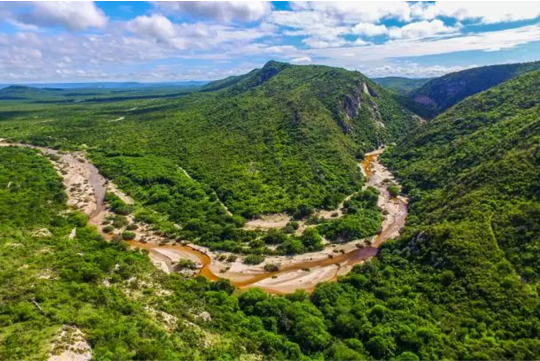
Discover Brazil and Explore the Geodiversity and Fossils of the Uberaba UNESCO Global Geopark
- Wayne Munday
- Sep 3, 2025
- 5 min read
Updated: Sep 10, 2025
Sip back and discover Brazil and explore the Uberaba UNESCO Global Geopark known as the Land of Brazilian Dinosaurs. Designated in 2024 this geopark is located within South America’s second largest biome after the Amazon Rainforest known as the Cerrado a vast tropical savanna region in central Brazil. More than 10,000 fossils have been unearthed in the region and among the most remarkable discoveries was Uberabatitan ribeiroi, the largest dinosaur ever found in Brazil, a colossal herbivorous quadrupedal titanosaur that reached an estimated 27 meters in length and 10 meters in height. Among the region’s most striking geological features are the Serra da Galga and Serra Geral formations, where ancient basalt flows preserve a record of massive volcanic events that preceded the breakup of the supercontinent of Gondwana and the opening of the South Atlantic Ocean. These basalt layers rest atop the sedimentary rocks of the Botucatu Formation that contains one of the world’s largest freshwater reserves. The name Uberaba originates from the Tupi term Y-berab, meaning clear water a reference to the abundant groundwater within the Uberaba Basin part of the Guarani Aquifer System.
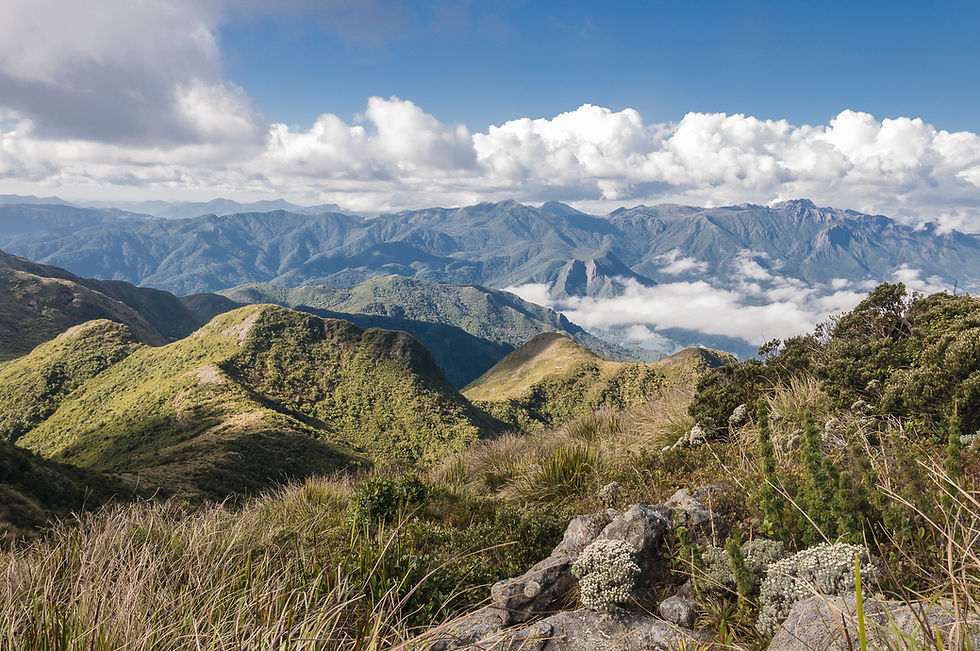
Since the mid-20th century, Uberaba, in the State of Minas Gerais, has been recognised as one of the most important fossil regions in Brazil. This part of the Bauru Basin preserves an exceptional fossil record dating back to the Late Cretaceous between 80 - 65 million years ago.
The first fossils were unearthed in 1945 during railway construction near Mangabeira station, north of Uberaba. These accidental finds drew the attention of paleontologist Llewellyn Ivor Price one of the first Brazilian palaeontologists. Then working with the Division of Geology and Mining his work would lead to the discovery and description of several new taxa. From 1946 to 1974, Price directed annual excavations at the fossil-rich Peirópolis sites sending specimens to Rio de Janeiro for study and curation. His work is credited to laying the foundation for much if modern paleontology in Brazil.

The Uberaba UNESCO Global Geopark offers the visitor a rare journey through landscapes shaped by ancient deserts, volcanic lava flows and floodplains that dinosaurs once walked upon over a period spanning over 130 million years. Just 25 kilometers from Uberaba is Peirópolis, known as Brazil’s “Dinosaur Capital” the base from where visitors can explore a number of geosites.

In 1991, Uberaba’s paleontological legacy was consolidated with the creation of the Llewellyn Ivor Price Paleontological Research Center and Dinosaur Museum in Peirópolis. Since its establishment, over one hundred scientific studies have been published, describing numerous new and unique taxa. The museum now has more than 4,000 fossil specimens, including dinosaurs, crocodyliforms, turtles, amphibians, fish, mammals, molluscs, crustaceans, ferns and trace fossils.

Many of the fossils are associated with the Uberaba and Marília formations and particularly the Serra da Galga Member of the Marília Formation. The Serra da Galga Formation was established as an independent lithostratigraphic unit in 2020. Located in Minas Gerais within the Upper Cretaceous Bauru Basin it tells a story of distributive river system developed in a semi-arid climate during the Maastrichtian Age between 72.2 - 66 million years ago, the last division of the Cretaceous Period, before the K-Pg mass extinction event that wiped out non-avian dinosaurs.

The fossils of Uberaba record a life lived in a semi-arid landscape with long dry seasons punctuated by short-lived episodic freshwater rivers and lakes. Fine sandstones and sediments deposited during sudden high-energy events such as flooding buried and preserved disarticulated remains, explaining why most fossils are fragmentary. Fully articulated specimens are rare but highly significant, such as the near complete fossil skeleton of Uberabasuchus terrificus, a crocodyliform.
The Late Cretaceous fossil record of Uberaba preserves a diverse assemblage of fish, amphibians, reptiles, plants, and invertebrates. Among its most notable finds are several key vertebrate groups that highlight the region’s paleontological significance.

Crocodyliforms are particularly diverse, with species such as Itasuchus jesuinoi, Peirosaurus tormini, Uberabasuchus terrificus, and Labidiosuchus amicum. The articulated specimen of Uberabasuchus terrificus is one of Brazil’s most iconic fossil discoveries and is displayed prominently at the Dinosaur Museum.

Freshwater turtles of the family Podocnemidae are also well represented, including Cambaremys langertoni, Peiropemys mezzalirai, and Pricemys caiera, offering critical insights into the evolutionary history of these long-lived reptiles.

Though less common, amphibians like Baurubatrachus pricei and Uberabatrachus carvalhoi reveal the diversity of anurans in ancient Uberaba, while lizards such as Pristiguana brasiliensis, a basal iguanid, mark some of the earliest members of this lineage. The ichthyofauna includes Amiiformes, Lepisosteiformes, Siluriformes, Characiformes, Osteoglossiformes and Dipnoi with some specimens assigned to the extinct Vidalamiinae a relative to bony ray-finned fish.
Dinosaurs dominate Uberaba’s fossil record, particularly titanosaurs like Baurutitan britoi, Trigonosaurus pricei, and Uberabatitan ribeiroi the latter discovered at Serra da Galga and recognized as Brazil’s largest known dinosaur. Theropods, including Abelisauria, Megaraptora, and Maniraptora, indicate a range of predators, with abelisaurids reaching up to eight meters in length and maniraptorans providing links to modern birds.

Uberaba also preserves evidence of reproductive behaviour, including a nesting ground of twenty titanosaur eggs in Ponte Alta the first such site documented in Brazil. Fragmentary avian fossils suggest the presence of extinct Mesozoic birds of the Enantiornithes, while later Quaternary deposits have yielded remains of the Giant Ground Sloth, Eremotherium laurillardi highlighting the region’s paleontological continuity into the Pleistocene-Holocene.
The Uberaba UNESCO Global Geopark in Brazil’s Cerrado biome offers a unique journey through 130 million years of geological and paleontological history. Home to over 10,000 fossils including Uberabatitan ribeiroi, Brazil’s largest dinosaur the geopark features striking geological formations such as the Serra da Galga and Serra Geral basalts, remnants of massive volcanic events predating Gondwana’s breakup, overlying the Botucatu Formation and the Guarani Aquifer. Since the mid-20th century, pioneering excavations by Llewellyn Ivor Price in Peirópolis uncovered the region’s first vertebrate fossils and Brazil’s largest dinosaur egg concentration. Today, Uberaba preserves a rich fossil record of crocodyliforms, freshwater turtles, amphibians, lizards, fish, and titanosaurs, offering insight into Late Cretaceous semi-arid ecosystems. Combined with a museums, research center, interpretive trails and urban dinosaur park, the Uberaba UNESCO Global Geopark uniquely blends scientific discovery, eco-tourism, and cultural heritage, making it a premier destination to explore Brazil’s dinosaur past.