


Discover Brazil and Explore the Geodiversity of the Seridó UNESCO Global Geopark
- Wayne Munday
- Sep 1, 2025
- 4 min read
Updated: Dec 20, 2025
The Seridó UNESCO Global Geopark in northeastern Brazil is a globally significant geological landscape showcasing some of South America’s oldest mineralised terrains. Designated in 2022, the geopark spans six municipalities in southern Rio Grande do Norte and is built upon the Paleoproterozoic Caicó Complex, later reshaped by the Brasiliano–Pan-African Orogeny during the assembly of West Gondwana. Granitic intrusions, metasomatism, and prolonged tectonic activity created exceptional deposits of tungsten, niobium, rare earth elements, and iconic gemstones such as Paraíba tourmaline. Today, Seridó combines ancient crustal evolution, mining heritage geosites like Mina Brejuí, and community-led geoconservation, offering a compelling model of sustainable geo-tourism and education.
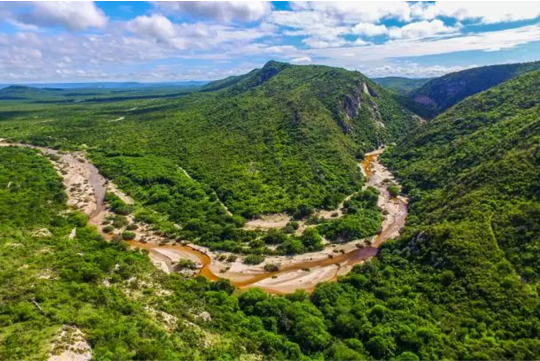
Designated as a UNESCO Global Geopark in 2022, the Seridó Geopark in North East Brazil covering the six municipalities Cerro Corá, Lagoa Nova, Currais Novos, Acari, Carnaúba dos Dantas and Parelhas in the southern part of Rio Grande do Norte State one of Brazil’s smallest states. Its capital, Natal, is renowned for the 16th-century Portuguese fortress Forte dos Reis Magos, as well as iconic coastal landmarks such as Ponta Negra Beach and the towering Morro do Careca dune. The state is also home to the Rocas Atoll the only atoll in the South Atlantic Ocean. Rio Grande do Norte offers a unique blend of pristine beaches, outdoor adventure and historical charm.
The foundation of the Seridó UNESCO Global Geopark lies on Paleoproterozoic crystalline rocks and represents one of the oldest geological foundations of South America. Formed by the convergence and collision of the Guiana Shield with the West-African Craton during the Trans-Amazonian Orogen between 2.26 1.98 billion years ago these rocks form the Caicó Complex and include high-grade gneisses, amphibolites, migmatites, and distinctive eye-shaped "augen" feldspar crystals.

The basement rocks would later undergo further intense deformation and metamorphism during the Brasiliano–Pan-African Orogeny between 800 - 500 million years ago forming the Seridó Group a sequence that overlay the Paleoproterozoic crystalline rocks known as the the Borborema Province within the Brazilian Shield and a key fragment in the assembly of the supercontinent West Gondwana.
Both the basement and the Seridó Group would be later intruded during the Ediacaran – Cambrian Periods by slow crystalising granitic intrusions forming skarn-type stockwork mineralisation along with mineralised pegmatites becoming important sources of porphyry-type deposits of rare minerals and gemstones in fine fractures and veins. Mineralisation was formed through the process of metasomatism where hydrothermal fluids altered the rock’s chemistry and mineralogy by introducing or removing elements forming new minerals and rock types. Unlike contact metamorphism, the process of metasomatism involved chemical change while the rock remains solid.
Later tectonic events added Cretaceous sandstones, mafic dykes and Cenozoic basaltic plugs that tell a story of a protracted evolution of the South American Platform and the source of significant natural resources and subsequent mining.
Mining has been central to Seridó’s identity for centuries and holds a landscape scattered with quarries and mines. The Borborema Province is a globally recognised as a significant metallogenetic region rich in Tungsten (W), Niobium (Nb), Molybdenum (Mo) and Rare Earth Elements (REEs) and gemstones such as Paraíba Tourmaline and Beryl.
The province also hosts valuable resources including Micas, Coltan, Lithium, Feldspar, Kaolin and Gold. The Borborema Province has significant Tungsten and Molybdenum or W–Mo skarn systems that hold economically significant ore deposits formed through metasomatism and also and mineralised pegmatites.

Located near to Currais Novos is Mina Brejuí the most significant geosite within the Seridó Geopark. Once a major tungsten mine it is now a cultural landmark and open air museum to mining preserving an industrial heritage of abandoned pits, underground galleries, processing plants, machinery, tailings a workers’ village complete with school and church.
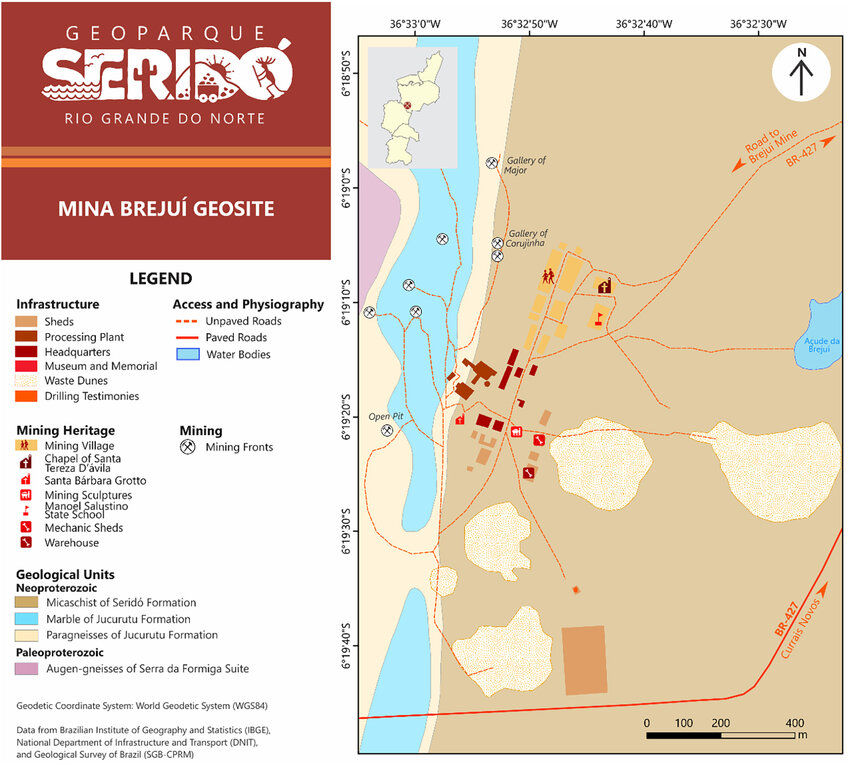
Mina Brejuí was known for its diverse mineralisation hosted in skarns of the Jucurutu Formation of the Seridó Group. Its primary ore is Scheelite the naturally occurring calcium tungstate (CaWO₄) mineral and a major ore of Tungsten. This geosite also features gold and bismuth along with minerals such as molybdenite, epidote and calcite.
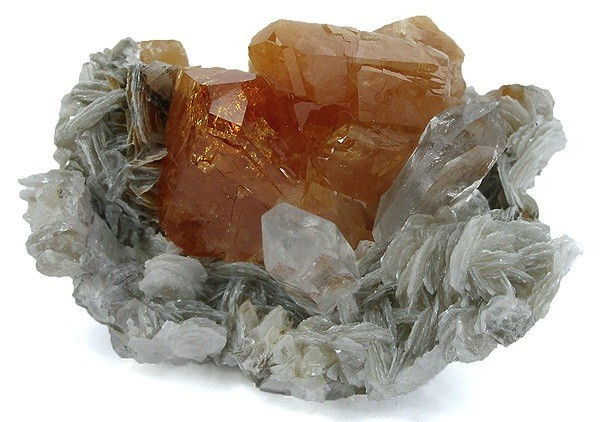
By contrast, an alternative geosite at the Seridó UNESCO Global Geopark is Açude Boqueirão in Parelhas known for its gemstones. This area is less industrial than Mina Brejuí but is home to the gem-bearing Boqueirão granitic pegmatite also known as Alto da Cabeça pegmatite. Here are global reserves of Tantalum, Beryllium and gemstones such as Aquamarine, Morganite and turquoise-blue Paraíba Tourmaline.
The Seridó UNESCO Global Geopark offers a unique window into both Earth’s deep geological history and the impact of industrial scale mining. Since its UNESCO designation, the geopark has been collaboratively managed by its six municipalities implementing a model that prioritizes geoconservation, education, and sustainable development to benefit both local communities and visitors. Geo-mining landscapes are preserved as scientific and cultural assets, while educational programs focus on climate change, natural hazards, and responsible resource management. Community involvement ensures that tourism and conservation initiatives support local livelihoods creating a balance between preservation and economic development.


