


Discover Canada and Explore the Fossils and Dinosaurs of Tumbler Ridge in British Columbia
- Oct 2, 2025
- 5 min read
Sip back and discover Canada and explore the fossils, dinosaurs and geodiversity of Tumbler Ridge UNESCO Global Geopark covering 8,478 Km² in the Hart Ranges on the eastern slopes of the northern Rocky Mountains in northeastern British Columbia. Here the bedrock is shaped by the Western Canadian Sedimentary Basin and includes the marine sandstones and shales of the Misinchinka Group and the Cambrian Gog Group, where ichnofossils such as Cruziana record early arthropod life. The Paleozoic limestones of the Palliser and Rundle formations preserve coral reefs, trilobites and have created karst landscapes while the Triassic Sulphur Mountain Formation yields marine reptiles and fish telling a story of recovery after the Permian–Triassic extinction. Tumbler Ridge is internationally renowned for its Cretaceous dinosaur record. The Flatbed Creek Tracksite preserves hundreds of footprints from ornithopods, ankylosaurs and theropods while the Wolverine River area revealed the world’s first parallel tyrannosaurid trackways. Subsequent excavations have uncovered bones of Boreonykus, Albertosaurus and ankylosaurs and British Columbia’s first nearly complete dinosaur skeleton of the "Tumbler Ridge Hadrosaur". The Tumbler Ridge Museum and Dinosaur Discovery Gallery connect these discoveries as a must-visit destination.
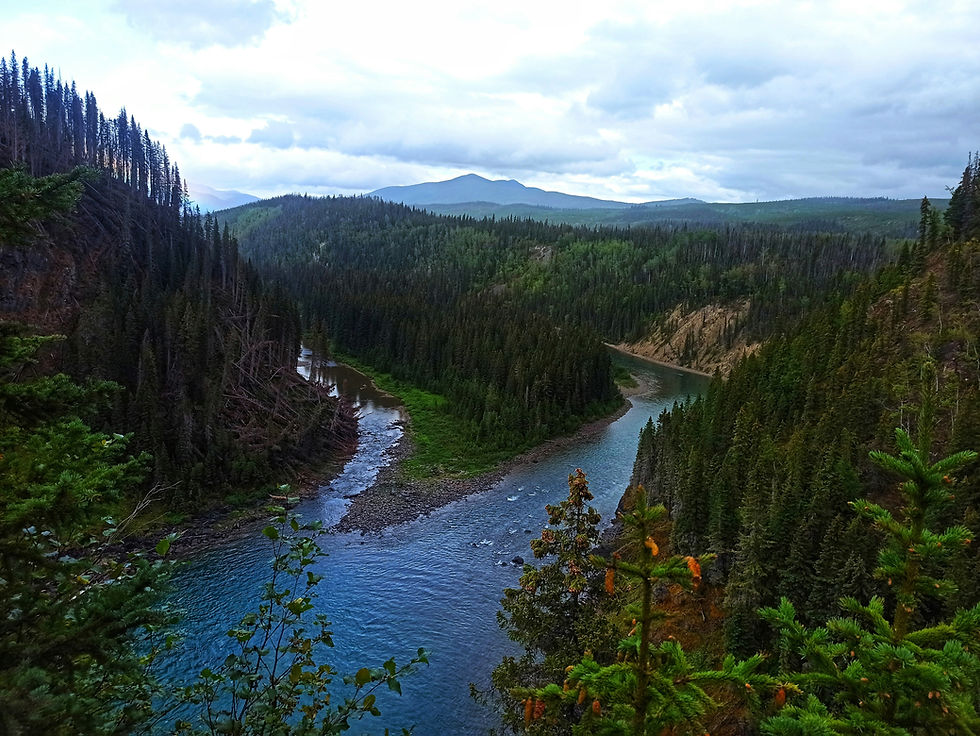
Tumbler Ridge UNESCO Global Geopark is found in the Hart Ranges on the eastern slopes of the northern Rocky Mountains in northeastern British Columbia. Tumbler Ridge is a road trip from Vancouver, Calgary and Edmonton so plan ahead. The geopark rises from the lowlands near the Murray River where Salt Creek joins the Murray to the glaciated summit of Bulley Glacier Peak. This is a landscape that spans nearly 600 million years from the Neoproterozoic to the Late Cretaceous and is shaped by repeated cycles of sedimentation, tectonic uplift and later by Quaternary glaciation.
The bedrock of Tumbler Ridge tells a story of nearly half a billion years. The oldest succession of rock formations are found within the Misinchinka Group one of the western most sequences of the Western Canadian Sedimentary Basin (WCSB). Here there has been an extensive history of sedimentary deposition and tectonic deformation with evidence of compression, folding, thrust faulting and basin subsidence as an outcome of mountain-building episodes to produce the rugged northern Canadian Rocky Mountains.

The sedimentary sandstones, shales and carbonate rock of the Misinchinka Group was laid down along a deep ancient continental ocean margin over hundreds of millions of years. Above the Misinchinka Group are the Cambrian quartzites of the Gog Group that mark the transition to a shallow marine environment along the early continental margin. The Gog Group across British Columbia and Alberta preserves relics of early Cambrian life captured not through body fossils but through ichnofossils or trace fossils left behind by arthropods and other invertebrates. Dating back roughly 570 – 525 million years these trace fossils include well-preserved trails such as Cruziana billingsi and Cruziana caputinclinata, which record the movements, feeding and burrowing behaviours on the seafloor.
Following the Gog Group is a Paleozoic carbonate platform including the Palliser and Rundle formations that both represent long intervals of warm tropical seas spanning from the Late Devonian to the Mississippian Period of the Early Carboniferous. The Mississippian Period represents the last time limestone was deposited by widespread seas on the North American continent.
The Palliser Formation was deposited around 370 million years ago and consists predominantly of limestone reef formed from lime mud and skeletal fragments in a warm shallow Devonian sea. Its well-exposed outcrops including the rock face at Bootski Lake preserve a rich diversity of marine fossils such as brachiopods, crinoids, gastropods, ostracods, conodonts, nautiloids, bryozoans and stromatolites.
Overlying the Devonian Palliser Formation is the limestone dominated Rundle Formation formed during the Mississippian Period approximately 340 – 350 million years ago also in warm shallow sea. This limestone is notable for its karst landscape where slightly acidic rainwater and groundwater has seeped through fractures gradually eroding the rock by dissolution to form caves, sinkholes, and disappearing streams. Fossils are embedded in limestone at sites such as Pinnacle Peak where an assemblage of well-preserved marine invertebrates including solitary and colonial corals, trilobites, brachiopods, crinoids, blastoids, ammonoids, clams, and bryozoans as well as trace fossils of seafloor burrows.
The Triassic Sulphur Mountain Formation in the Tumbler Ridge area preserves fossils from an open-ocean ecosystem during the Early to Middle Triassic. Well-preserved fossil fish and marine reptiles at sites like Windfall Lake expose steep sandstone and siltstone cliffs and extensive talus slopes that have yielded fossils of marine recovery after the Permian–Triassic extinction. Fossil assemblages include fish fossils such as ganoid-scaled fishes, the coelacanth Rebellatrix divaricerca, early grippidian ichthyopterygian reptiles such as Gulosaurus (means "Helm's wolverine lizard"), ammonoids, brachiopods, bivalves, conodonts and microbial mat traces. Ichnofossils including the large burrowing systems of Thalassinoides, Planolites and Zoophycos produced by moving and feeding worms record seafloor behaviour in detail. Importantly, during this time there was coastal progradation where there was a seaward advance of the shoreline over time due to the accumulation of sediment causing the coastline to build out into the sea.
During the Jurassic and Cretaceous periods saw the rise of the Cordilleran mountain building event and the Western Canadian Foreland Basin accumulated vast sequences of sandstones, shales, and coals. This was a time when the sea regressed allowing lush vegetated delta swamps to grow and accumulate plant material that later would become the economically important coal seams of the Gething and Gates formations that historically underpinned local industry around Tumbler Ridge.

Tumbler Ridge Global Geopark has emerged as one of Canada’s most important fossil regions especially for the Cretaceous Period. Though footprints have been found in the rock for many years it was the significance of the discovery of the Flatbed Creek Tracksite in 2000, the province’s first major dinosaur footprint trackway, followed by additional sites along the Wolverine River that produced extraordinary theropod footprints and the world’s first parallel tyrannosaurid trackways.
The Flatbed Dinosaur Trackway was discovered in 2000 by two local children tubing down the creek the site preserves hundreds of dinosaur footprints dating back about 95 million years to the mid-Cretaceous. The numerous tracks are impressed into sandstone that once formed the muddy banks of a prehistoric waterway, record the movements of ornithopods, ankylosaurs and especially three-toed theropods. Leading down toward the creek the trackways suggest that dinosaurs may have gathered at this ancient riverbank to drink or forage. Best viewed when wet, the footprints offer visitors a rare chance to see and touch direct evidence of dinosaur behaviour in the landscape. This is the largest concentration of dinosaur tracks ever found in British Columbia and helped establish the Tumbler Ridge Museum Foundation.
These trackways are especially significant because they capture dinosaur behaviour, movement and even possible social interactions the information that is rarely preserved in bones alone. Complementing the dinosaur record are rare skin impressions and marine fossils that speak to earlier inland sea environments.
In 2023, the region yielded another landmark discovery: the first North American evidence of tail-clubbed ankylosaurid trackways. Excavations have also revealed a wealth of skeletal fossils, including bones of the dromaeosaurid Boreonykus, the tyrannosaurid Albertosaurus, nodosaurid ankylosaurs, and British Columbia’s first nearly complete dinosaur skeleton of the "Tumbler Ridge hadrosaur" a duck-billed dinosaur discovered in Quality Creek and now on display housed at Dinosaur Discovery Gallery at Tumbler Ridge Museum.


