


Discover the Arenig Age and Explore the Fossils and Geodiversity That Shaped Our Planet
- Aug 16, 2025
- 4 min read
Updated: Sep 11, 2025
Sip back and discover the Arenig Age spanning from 477.7 - 470 million years ago and explore this key subdivision of the Early Ordovician epoch. Also called the Arenigian, this stage follows the Tremadocian and precedes the Dapingian or Llanvirnian with its global equivalent recognised as the Floian Stage by the International Commission on Stratigraphy (ICS). Originally defined by Adam Sedgwick in North Wales the Arenig is characterised by transgressive sedimentary sequences and dynamic tectonic activity including rifting, volcanism and subduction that shaped important geological formations across the British Isles and beyond. During the Arenig, the supercontinent Gondwana dominated the southern hemisphere while smaller landmasses drifted near the equator separated by the Iapetus Ocean. The climate was warm and sea levels rose expanding shallow seas that encouraged diverse marine ecosystems. This period marks the Great Ordovician Biodiversification Event (GOBE) a rapid increase in marine biodiversity featuring graptolites, trilobites, brachiopods, cephalopods and the emergence of early reef structures.
The Global Boundary Stratotype Section and Point (GSSP) or the internationally agreed-upon reference point in a geological record that marks the lower boundary of the Floian is located in Diabasbrottet, Hunneberg, Sweden in the Lower Tøyen Shale (58.3589°N 12.5024°E). This siliciclastic mudstone from the Lower to Middle Ordovician is found mainly in southern Sweden’s Scania and is known for its well-preserved graptolite fossils.
The Västergötland region of west-central Sweden preserves remnants of the Lower Palaeozoic succession, protected by thick Permian dolerite sills formed during late Palaeozoic rifting. At Hunneberg and Halleberg, these sills created steep cliffs that shielded underlying Cambrian–Ordovician sediments, which were historically mined, exposing rich fossil-bearing strata.
Early investigations by Swedish geologists such as Hisinger, Angelin, Linnarsson, and Westergård established the region’s importance for trilobite and graptolite studies. Hunneberg became especially significant for its Lower Ordovician graptolite assemblages culminating in the designation of the Diabasbrottet section as the Global Boundary Stratotype Section and Point (GSSP) for the base of the Floian Stage marked by the first appearance of the Graptolite Paratetragraptus approximatus.

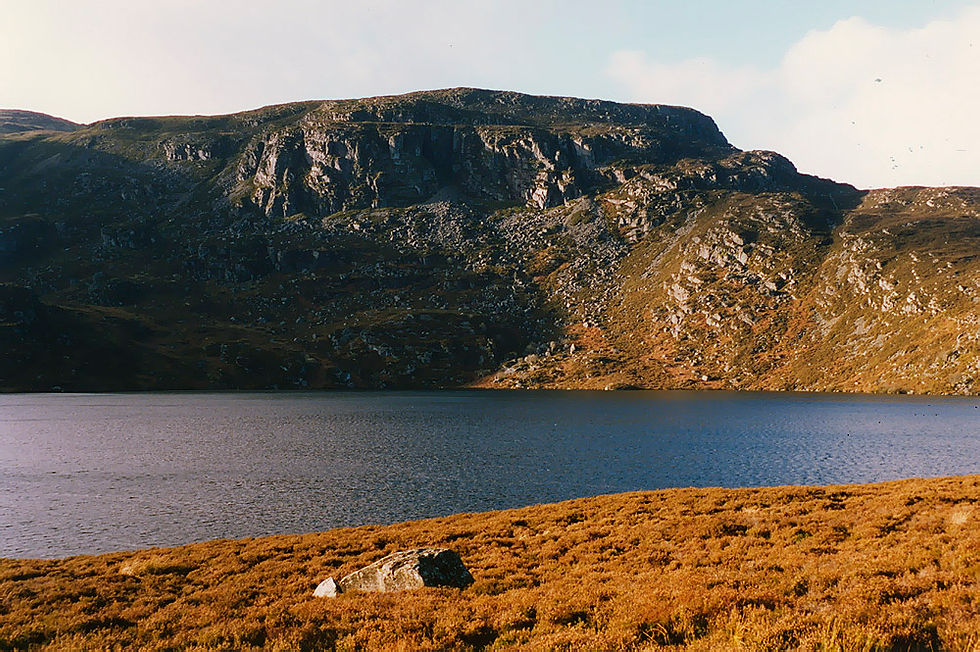
Originally defined by the British geologist Adam Sedgwick in the mid-19th century the Arenig was originally named after Arenig Fawr a mountain in North Wales where rich fossil-bearing sedimentary rocks were first studied. While the section at Arenig Fawr is incomplete, more continuous and detailed sequences occur in South Wales providing valuable insight into this early Ordovician interval.
The Arenig marks a period of important geological and biological developments. It represents a transgressive sedimentary phase in Wales following a regression at the end of the Tremadocian and is subdivided locally into stages such as the Moridunian, Whitlandian, and Fennian. In broader terms, the age is characterised by dynamic tectonic activity including rifting, arc volcanism, and subduction which shaped basins like those of the Borrowdale Volcanic Group in England and the Ballantrae Complex in southwestern Scotland. Sedimentary rocks of Arenig age also occur in the Manx Group of northern England further illustrating the widespread geological processes at work.

The global paleogeography during the Arenig featured the supercontinent Gondwana dominating the southern hemisphere while Laurentia, Baltica, Siberia, and microcontinents like Avalonia drifted across equatorial and temperate latitudes. The Iapetus Ocean separated these landmasses, its tectonic evolution profoundly influencing Paleozoic geological history. The early stages of the Caledonian orogeny began during this time as terranes rifted from Gondwana and moved toward Laurentia, setting the stage for future mountain building.
Climatically, the Arenig was marked by a mild greenhouse state with warm surface waters and rising sea levels that expanded shallow epicontinental seas worldwide. These well-oxygenated marine environments sustained diverse ecosystems, though localised dysoxic conditions occasionally developed, as seen in black shale deposits. Notably, there is no evidence for glaciation during this interval.
Biologically, the Arenig is a key chapter in the Great Ordovician Biodiversification Event (GOBE) a major evolutionary radiation that vastly increased marine biodiversity and ecological complexity. Fossil assemblages from this period include a diverse array of graptolites like Tetragraptus akzharensis, conodonts, brachiopods, trilobites, cephalopods and early echinoderms such as cystoids and crinoids. Trilobite genera like Megistaspis and Asaphus were common across Laurentia, Baltica, and Gondwana, reflecting intricate biogeographic patterns influenced by plate tectonics and ocean circulation.

Marine ecosystems grew more stratified, with planktonic organisms establishing vertical zones and benthic communities becoming increasingly complex. Early reef-like structures composed of stromatoporoids, bryozoans, and microbialites emerged, highlighting ecological innovation. Meanwhile, the fossil record preserves a wide range of sedimentary environments from deep-water graptolite-rich shales of the Skiddaw Group in northwest England to shallow marine limestones and sandstones in Morocco’s Fezouata Formation the latter containing exceptionally preserved transitional Cambrian-Ordovician faunas.
The Arenig Age offers a remarkable window into one of the most dynamic intervals of Earth history. Spanning nearly eight million years of the Early Ordovician, it was a time of shifting continents, rising seas and flourishing life. The warm greenhouse climate expanded shallow marine environments that nurtured the Great Ordovician Biodiversification Event when trilobites, graptolites, brachiopods, cephalopods and the earliest reef ecosystems flourished. Across Wales, England, Scotland, and beyond, tectonic activity and volcanism left their mark in rocks that still record the drama of rifting oceans and the first stirrings of the Caledonian mountain-building events. Equally significant is the Arenig’s role in global stratigraphy. While Adam Sedgwick first defined the stage in North Wales, the most precise reference point lies at Diabasbrottet in Hunneberg, Sweden. Here, the appearance of the graptolite Paratetragraptus approximatus defines the internationally recognised “golden spike” for the base of the Florian Stage a level that allows geologists to correlate rock layers and fossil faunas across continents. For today’s visitors, whether hiking Arenig Fawr in Wales or exploring the cliffs of Hunneberg the Arenig represents more than deep time it is a living connection to Earth’s evolving landscapes, ancient oceans and the rich fossil heritage that continues to inspire science and discovery.

