Discover Canada and Explore the Fossils and Geodiversity of Blue Beach in Nova Scotia
- Wayne Munday
- Oct 14, 2025
- 6 min read
Updated: Dec 19, 2025
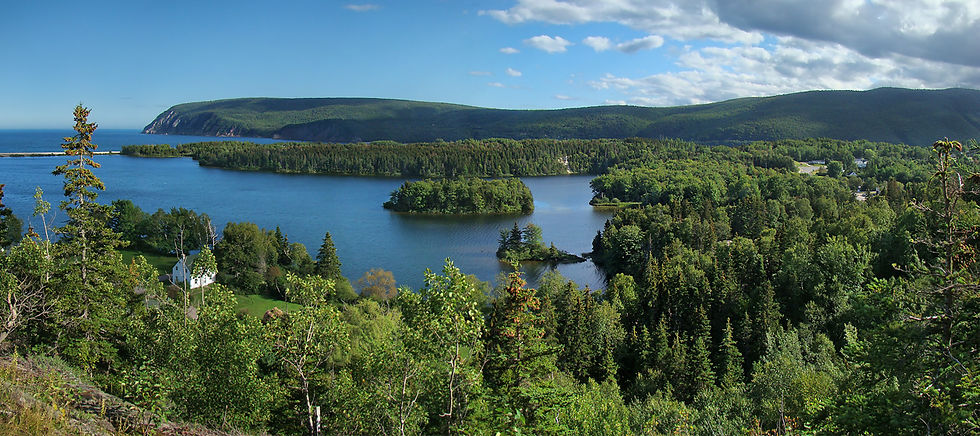
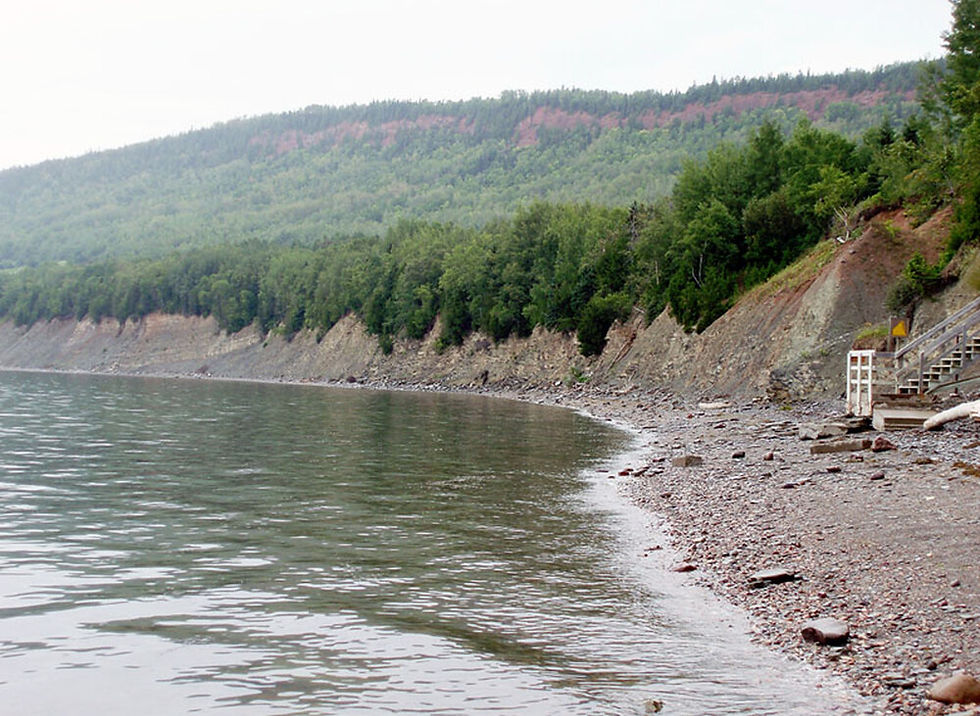
Sip back and discover Canada and explore the fossils and geodiversity of Blue Beach located on the shores of the Minas Basin near Avonport in Kings County, Nova Scotia. This is one of Canada’s most extraordinary fossil localities and a highlight of the Cliffs of Fundy UNESCO Global Geopark. Blue Beach is a 2 Km stretch of coast, carved daily by the world’s highest tides of the Bay of Fundy and exposes the rocks and fossils of the Horton Bluff Formation dating from 385 - 345 million years ago during the Devonian–Carboniferous transition. Within this formation, the Blue Beach Member preserves rare fossils indicative of Romer’s Gap a 20-million-year interval lacking early terrestrial vertebrates. Blue Beach has uncovered some of the earliest four and five-toed tetrapod footprints, alongside fish, millipedes and swamp plants like Lepidodendron and Calamites. Trace fossils such as Hylopus logani and Eochelysipus horni capture early animals venturing from water to land, bridging the evolutionary divide between fish and amphibians. Today, the Blue Beach Fossil Museum and guided tours let visitors explore this globally significant site where Earth’s first land walkers left their mark.

Blue Beach is located on the shores of the Minas Basin in Nova Scotia about halfway between the towns of Hantsport and Avonport in Kings County. It sits on the northern edge of the Bay of Fundy, an area world-famous for having the highest tides on Earth, which can rise and fall by more than 16 metres each day. This fossil site lies roughly 70 Km northwest of Halifax, Nova Scotia’s capital city, making it an easy day trip from the province’s main urban centre. Visitors typically reach Blue Beach by taking Highway 101 and following signs to Blue Beach Road which leads directly to the coastline and the Blue Beach Fossil Museum where you can take a Fossil Tour as digging at or tampering in any way with the cliffs is not only dangerous from rock fall it is prohibited under Nova Scotia law.
Located within the Cliffs of Fundy UNESCO Global Geopark Blue Beach is a small and unassuming 2 Km stretch of coastline that holds one of the world’s most remarkable fossil records that tells a story about when life was taking its first steps onto land.

The immense tidal surges in the Bay of Fundy shapes this landscape daily, carving into the soft cliffs of the Horton Bluff Formation part of the early Carboniferous Horton Group exposing new discoveries every tide.
The Horton Bluff Formation within the Horton Group of Nova Scotia dates from between 385 – 345 million years ago spanning the Strunian the final substage of the Late Famennian in the Devonian Period and transitions predominantly into the Tournaisian Stage the lowest of three intercontinental stages of the Mississippian and Lower Carboniferous period. This time has a particular importance because it is within the 20-million-year interval following the Devonian extinction known as Romer’s Gap.
Romer’s Gap refers to a marked scarcity of terrestrial vertebrate fossils and especially early tetrapod's. Named after palaeontologist Alfred Sherwood Romer this gap refers to a missing record between Devonian lobe-finned fish and the more advanced early Carboniferous amphibians and reptiles at a time when land ecosystems were recovering and again diversifying.
Blue Beach along with other related fossil finds at the East Kirkton Quarry and at Burnmouth in Scotland are collectively closing this gap. East Kirkton (≈346 Ma) has yielded iconic tetrapod's such as Westlothiana lizziae and Balanerpeton woodi a temnospondyl amphibian showing five-toed terrestrial capability. Discoveries in Burnmouth’s Ballagan Formation (≈348–346.6 Ma) include the stem tetrapod's of Aytonerpeton known as the "tiny creeping thing from Ayton" and Diploradus. Both Scottish sites, not unlike Blue Beach, record a coastal wetland and reveal that early tetrapod's and fish had already evolved key terrestrial adaptations such as limbs and lungs. Notably, dinosaurs are absent from Blue Beach because they evolved more than 100 million years later in the Mesozoic Era.

The Horton Bluff Formation is a complex sequence of four marginal river and lake deposits including the Harding Brook, Curry Brook, Blue Beach and capped by the Hurd Creek Member. During the Carboniferous, this region lay along the equator and formed part of a vast humid foreland basin bordering the rising Appalachian Mountains. Sediments of grey to black sandstones, siltstones, shales and conglomerates often rich in quartz and altered feldspar or kaolinite was washed down into a network of rivers, floodplains and lagoon where they accumulated in thick and alternating beds extending across the Maritimes Basin reaching between 350 to over 1,000 meters in thickness. Pleistocene glaciers would much later scour this region leaving behind a rugged coastal terrain that continues to evolve today under the force of the Fundy tides.

It is the Blue Beach Member that is home for the Blue Beach fossil site. Laid down in a marginal marine ecosystem or a large lake that was periodically connected to the sea. The presence of both palaeophycus and rusophycus trace fossils at Blue Beach provides further key insights into its paleoenvironment. Palaeophycus trace fossils are horizontal burrows created by worm-like organisms and reflects a well-oxygenated, soft and stable substrate where these animals could feed and live with minimal disturbance from strong currents. By contrast, rusophycus trace fossils are resting or digging marks from benthic activity in shallow waters where animals intermittently settled or foraged. This combination of dwelling and resting traces is consistent with a tidally influenced or shallow marine environment.
Over time, these sediments were buried, compacted and lithified into rock that preserved the delicate imprints of footprints, bones and plants that once inhabited this tropical landscape. Among the mudstones and siltstones the fossil record of Blue Beach are some the oldest known trace fossils of four and five toed tetrapod footprints on Earth together with fishes, marine and nonmarine invertebrates and early land plants that are now curated at the Blue Beach Museum.
Blue Beach captures the transition between marine/brackish and terrestrial ecosystems and among its invertebrates are microconchids (“Spirorbis”), ostracodes, conchostracans (clam shrimp), Euproops and agglutinated foraminifers suggesting they were also deposited in a marginal marine setting such as a lagoon. Among the invertebrate trackways are signs of horseshoe crab from Paleolimulus woodae. On land rare millipede trace fossils of Diplichnites and Diplopodichnus provide clear evidence that millipedes also inhabited the forested wetlands.

Among the plant fossils are Lepidodendron, Calamites and Aneimites, together with spores and pollen that also reflect a lush swampy floodplains that supported the early coal forests. Other key discoveries include fossil charcoal or fusain from wildfires.
The most striking feature of the vertebrate fossils of the Blue Beach Member is its diversity of fish including ray-finned fish such as Elonichthys and Rhadinichthys, lungfish, sharks and massive rhizodonts like the predatory Avonichthys manskyi which is unique to Blue Beach.
What makes Blue Beach remarkable is its fossils of early tetrapod's and evidence of the first four-limbed vertebrates to venture onto land. Blue Beach has produced both body fossils and trace fossils from these pioneering animals. Bones such as humeri, femora, and skull fragments have been recovered while hundreds of trackways record their movements across mudflats and tidal surfaces.
These footprints were first observed 1841 at Blue Beach (then Horton Bluff) by Sir William Logan and is thought to be the first person to recognise these Carboniferous vertebrate trackways in North America. These observations laid the foundation for future tetrapod research particularly at Joggins Fossil Cliffs where he undertook bed-by-bed studies of early amphibians and reptiles as a one of the two initial field projects founding the Geological Survey of Canada. It was not until 1863 when Canadian geologist Sir William Dawson first published a brief description of the tracks and referring to them as "footprints discovered by Sir W. E. Logan". The ichnospecies of Hylopus logani was formally named by Sir William Dawson in 1882 to honour Sir William Logan and his pioneering geological work in Canada.

Over 2,000 small individual tetrapod footprints have now been found at Blue Beach representing multiple species and behaviours. Ranging from displaying three main toes and a smaller lateral toe indicating primitive walking gaits to more complex five-toed or pentadactyl tracks demonstrating the standard vertebrate limb pattern.
Discoveries have included the tracks of Eochelysipus horni, a broad-gaited vertebrate with five-toed hind limbs, inwardly positioned forelimbs and elongate forward-sweeping scrape marks suggesting it may belong to an early parareptile closely related to ancestral turtles. Another is the trackway of the stem reptile Peratodactylopus bishopi a captorhinomorph reptile and a heavy footed Baropezia. Together, these ichnotraces or trace fossils show a continuum of life from aquatic to terrestrial organisms and bridge the ecological gap between fish and fully land living dwelling amphibians.
Blue Beach offers visitors an unparalleled hands-on experience of deep time where the fossils of fish, amphibians and plants lie scattered among the wave-washed stones and has left behind footprints that mark one of the most important evolutionary steps in the history of life on Earth.